

In Greek mythology, Sirens were legendary beings whose beautiful, irresistible songs captivated sailors and could distract them from their intended journey. Often represented in modern culture as mermaid-like figures, Sirens have become a powerful symbol of attraction—and the importance of keeping the destination in sight.
For healthcare businesses, convenience can create a similar Siren effect.
GoDaddy offers an attractive starting point: domains, website tools, hosting, email, and other services within one ecosystem. Especially in the early stages of a business, that simplicity and convenience can be valuable.
But healthcare businesses are different. As they grow, their websites may need to support more complex SEO, educational content, integrations, automation, storage, security considerations, online learning, and sophisticated marketing strategies. What worked well at the beginning may therefore deserve reassessment later.
At Elysian Medicina Digital Marketing (EMDM), we are not suggesting that healthcare businesses should leave GoDaddy—or that convenience is a disadvantage. Our focus is strategic reassessment: understanding when convenience continues to serve the destination and when evolving costs, technical needs, or limitations deserve a closer look.
The goal is to enjoy the Siren song of convenience without losing sight of where your business is trying to go.
Why Healthcare Professionals May Choose GoDaddy
GoDaddy can be attractive to healthcare entrepreneurs who want to establish an online presence without managing multiple technology providers from the beginning.
Depending on the products and plan selected, businesses may use the ecosystem for:
Domain registration
Website creation and hosting
Business email
Appointment or contact functionality
Marketing tools
Basic website management
Quick business launches
An integrated ecosystem

For a new private practice, healthcare consultant, nurse entrepreneur, educator, or other small organization with straightforward website requirements, this type of setup can provide a practical way to get started.
The important consideration is not whether a platform is popular or convenient, but whether its specific features, plan limits, and technical capabilities match the needs of the organization using it.
The Difference Between Starting a Website and Scaling One
A website that works well during the launch stage may need additional capabilities as a healthcare business grows. This is a normal part of digital expansion and can happen on almost any platform.
Over time, healthcare organizations may add:
- Continuing education portals
- Patient education libraries
- Large video libraries
- Case studies
- Testimonials
- Membership areas
- Learning Management Systems (LMS)
- CRM integrations
- Scheduling platforms
- Email automations
- Marketing analytics
- HIPAA-conscious workflows
- Advanced SEO infrastructure
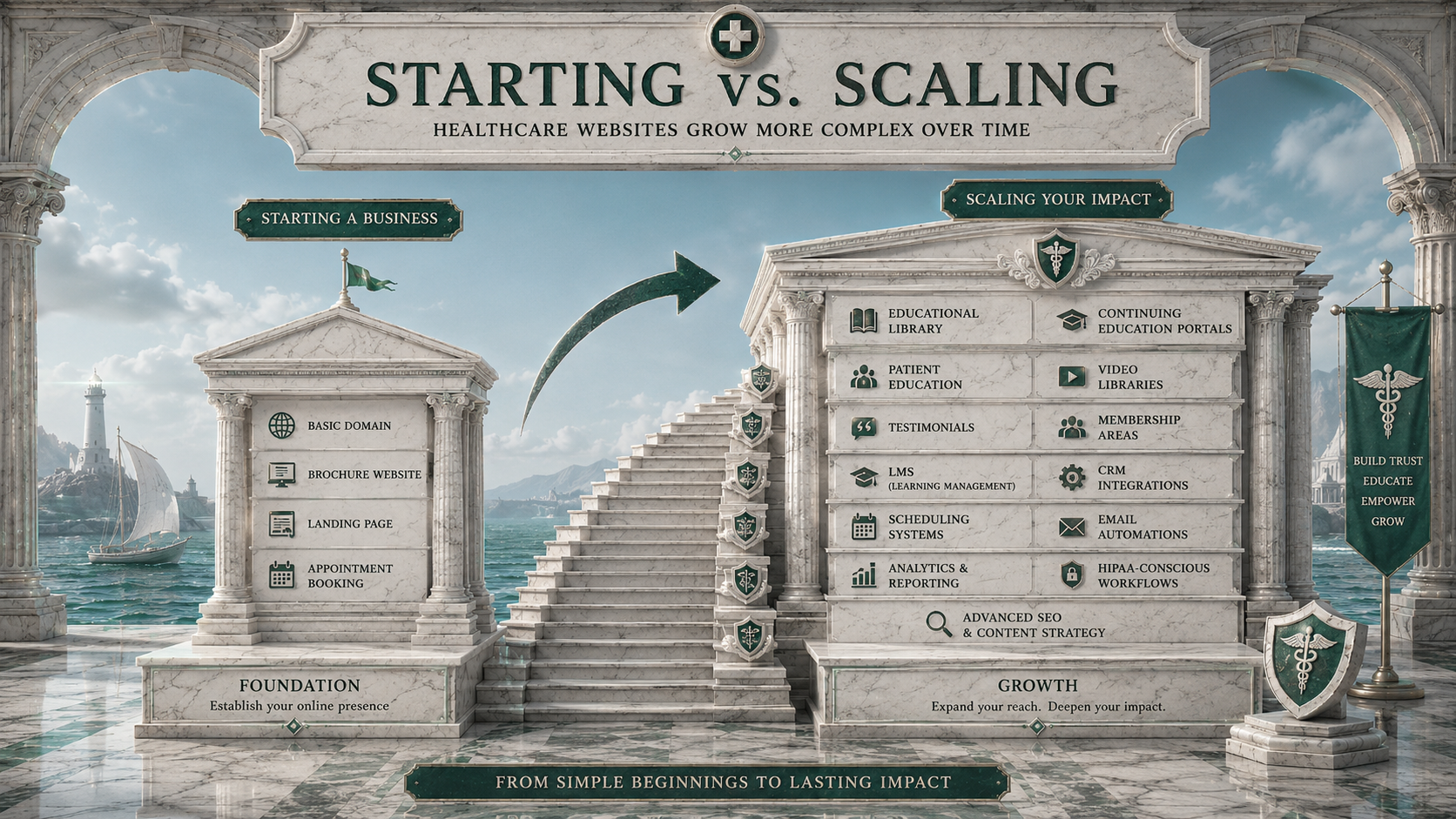
These additions can change the amount of storage, bandwidth, customization, development, security planning, and technical support an organization requires.
That is why it is useful to review your website infrastructure periodically instead of assuming that the solution selected at launch will automatically remain the best fit forever.
What We Have Learned From Healthcare Website Projects
At EMDM, we have worked with healthcare organizations whose websites became more complex as their educational, marketing, and operational needs expanded.
In one project protected under a non-disclosure agreement, the organization was developing a more sophisticated educational platform with additional plugins, resources, media, and functionality.
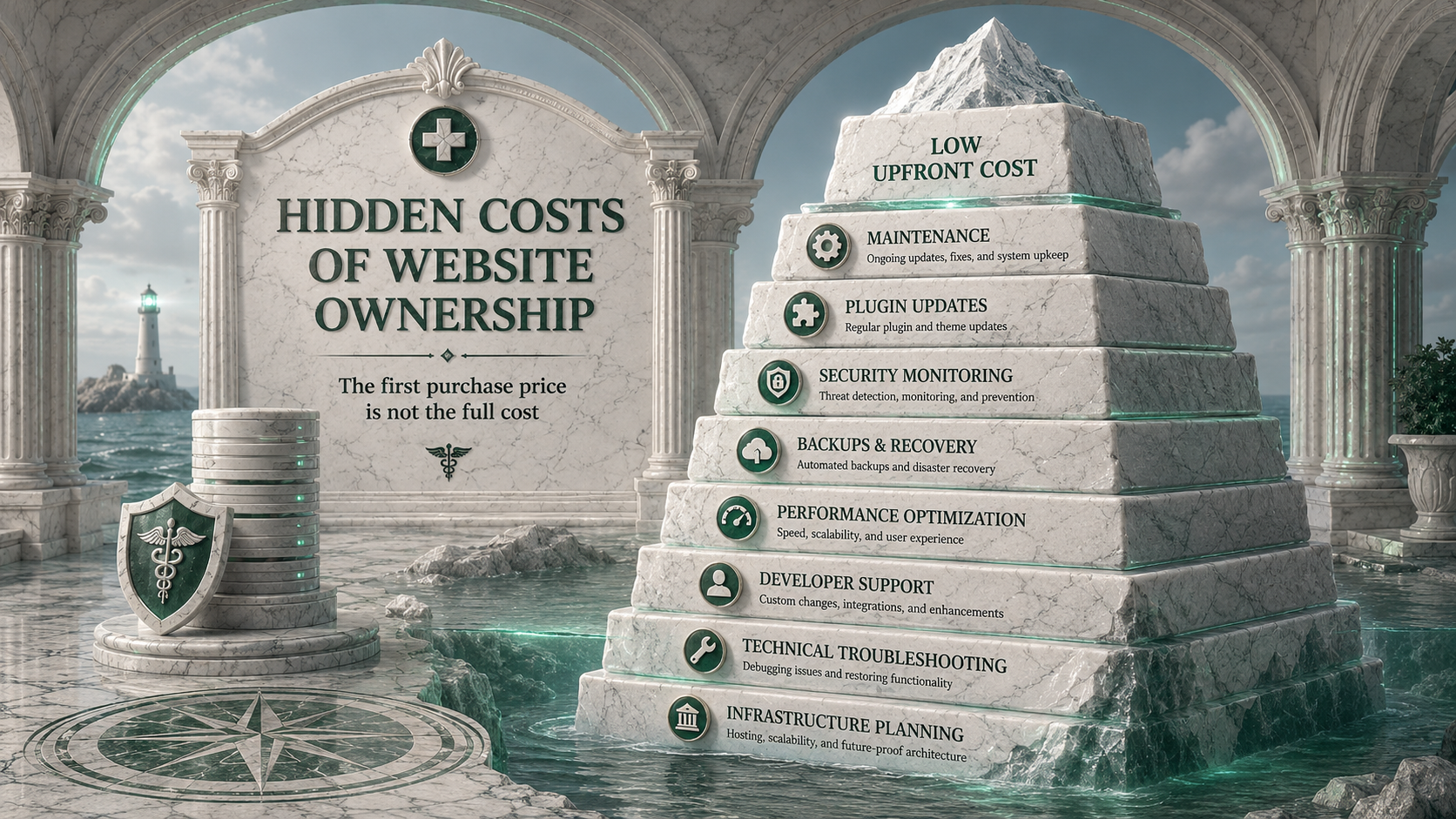
As the website grew, our team had to evaluate several technical considerations, including plugin compatibility, website performance, storage, and the overall structure needed to support the expanding content library.
This experience reinforced an important point: infrastructure decisions should be based on the actual needs of the project, not simply on the platform name.
Growth changes requirements. A website may need a different plan, configuration, architecture, or platform as the organization evolves.
In some situations, an upgrade within the existing platform may be enough. In others, technical optimization or a different infrastructure approach may make more sense.
The right decision depends on the website, the business model, the content strategy, and the organization's future plans.
Healthcare Websites Have Additional Considerations
Healthcare organizations often use their websites for more than general business information. A website may support education, communication, scheduling, marketing, professional credibility, and in some cases workflows involving sensitive information.
This can apply to organizations and professionals such as:
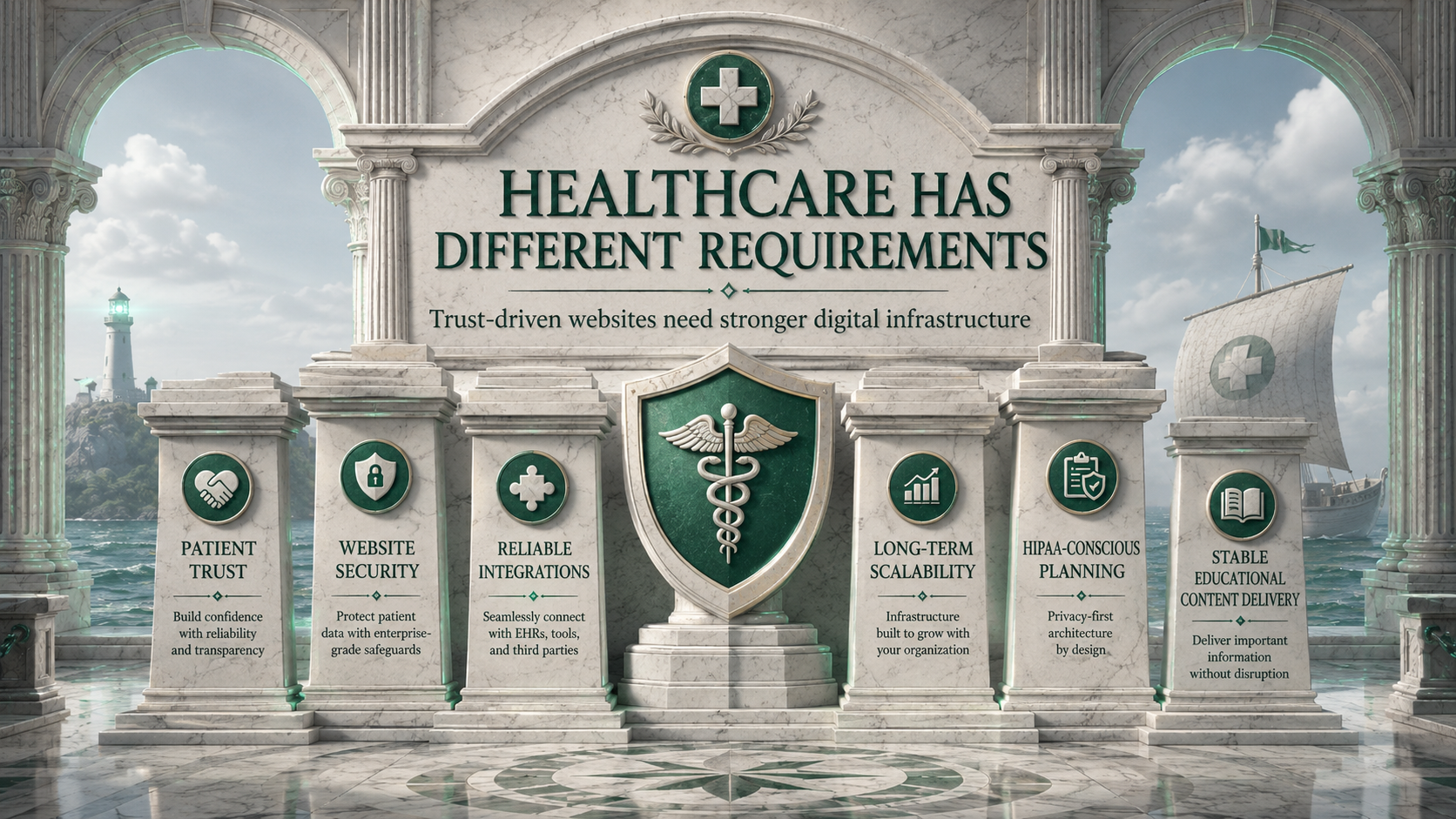
Depending on the organization and how the website is used, infrastructure planning may need to account for:
- Patient and audience trust
- Website security
- Reliable integrations
- Long-term scalability
- HIPAA-conscious technology planning
- Stable educational content delivery
Important: HIPAA compliance is not determined by choosing a particular domain registrar, website builder, or hosting company by itself.
Compliance considerations depend on the specific services being used, the type of information being collected or transmitted, applicable agreements, integrations, configurations, security controls, and the organization's own processes.
Healthcare organizations should evaluate the complete technology stack and seek appropriate compliance guidance when protected health information or regulated workflows are involved.
Templates Are a Starting Point—Brand Strategy Goes Further
Templates can be useful. They can reduce development time, provide visual structure, and help a new business launch more quickly.
But the template itself is only one part of how a healthcare organization presents its brand.
A strong healthcare brand also considers:

Messaging, photography, typography, color, educational content, user experience, positioning, and consistency all contribute to how patients and professional audiences perceive an organization.
Whether a website begins with a template or a custom design, the goal should be to make the final experience feel aligned with the organization's identity and audience.
Technical Support Is Only One Part of the Decision
Support experiences can vary across every technology company and may depend on the product, plan, technical issue, and level of service selected.
When evaluating any website provider, healthcare businesses should look beyond a single support interaction and consider the broader picture: documentation, available support channels, upgrade options, developer access, backup capabilities, performance tools, and the level of internal technical knowledge available to the organization.
Sometimes a technical issue can be resolved through configuration or optimization. Sometimes a plan upgrade is appropriate. In other cases, a larger architectural change may be worth considering.
The objective is not to avoid upgrades. It is to understand why an upgrade is needed and whether it supports the organization's long-term strategy.
When GoDaddy May Be a Good Fit—and When to Reassess
There is no single website platform that is ideal for every healthcare business. The best choice depends on the organization's size, budget, technical requirements, content strategy, internal resources, and growth plans.
- First-time entrepreneurs
- Small businesses with straightforward website needs
- Landing pages
- Single-page funnels
- Portfolio websites
- Appointment-focused websites
- MVP launches
- Businesses validating a new idea
- Organizations with limited content requirements
- Large educational libraries
- Online healthcare courses
- Membership communities
- Extensive SEO infrastructure
- Heavy custom development
- Advanced integrations
- Greater scalability
- Multiple APIs
- Complex CRM automations
- HIPAA-conscious workflows
- High-volume content publishing

Reassessing your infrastructure does not automatically mean migrating away from your current provider. It may simply mean reviewing your plan, optimizing the website, changing how media is stored, improving integrations, or adopting additional tools.
Questions to Ask Before Making a Change
Before moving platforms, consider what problem you are actually trying to solve. Is it performance? Storage? Customization? Integrations? Compliance planning? Content volume? Development flexibility? Cost?
Once the real requirement is clear, it becomes much easier to determine whether the best next step is optimization, an upgrade, a new architecture, or a different platform.
Final Thoughts
The Siren metaphor is ultimately about careful navigation, not fear. An attractive option can still be a useful option.
Convenience is valuable, especially when a healthcare business is getting started. But digital infrastructure should be reviewed as the organization grows and its requirements become more sophisticated.
The goal is not to find a platform that is universally “best.” The goal is to choose technology that fits your organization at the stage you are in—and can support where you plan to go next.
GoDaddy may be a practical solution for some healthcare businesses, while others may eventually require different plans, additional tools, more customized infrastructure, or another platform entirely.
Just as sailors in old stories needed to understand the waters ahead rather than navigate by appearance alone, healthcare organizations benefit from evaluating technology based on documented requirements, future plans, and long-term fit.
Elysian Medicina Digital Marketing helps healthcare organizations evaluate website strategy, architecture, branding, SEO, infrastructure planning, and scalable digital marketing systems.
A website assessment can help identify what is working well, what may need improvement, and whether your current technology still supports your goals.
Request a Digital Footprint Assessment